How to Select the Right Helical Spring: Compression, Tension & Torsion Explained
Learn how to select the right helical spring for your application. Compare compression, tension, and torsion springs, understand key design parameters like wire diameter, spring rate, and material selection, and avoid common mistakes.
Introduction: Why Spring Selection Matters
Helical springs are everywhere — from ballpoint pens and garage doors to automotive suspensions and semiconductor handling equipment. Yet selecting the wrong spring type or size can lead to premature failure, inconsistent performance, and costly redesigns.
This guide explains the three main types of helical springs — compression, tension (extension), and torsion — and provides a practical framework for choosing the right spring for your mechanical application.
What Is a Helical Spring?
A helical spring is a mechanical device made from wire coiled into a helix (spiral) shape. When a force is applied, the spring stores mechanical energy by deforming elastically; when the force is removed, it returns to its original shape.
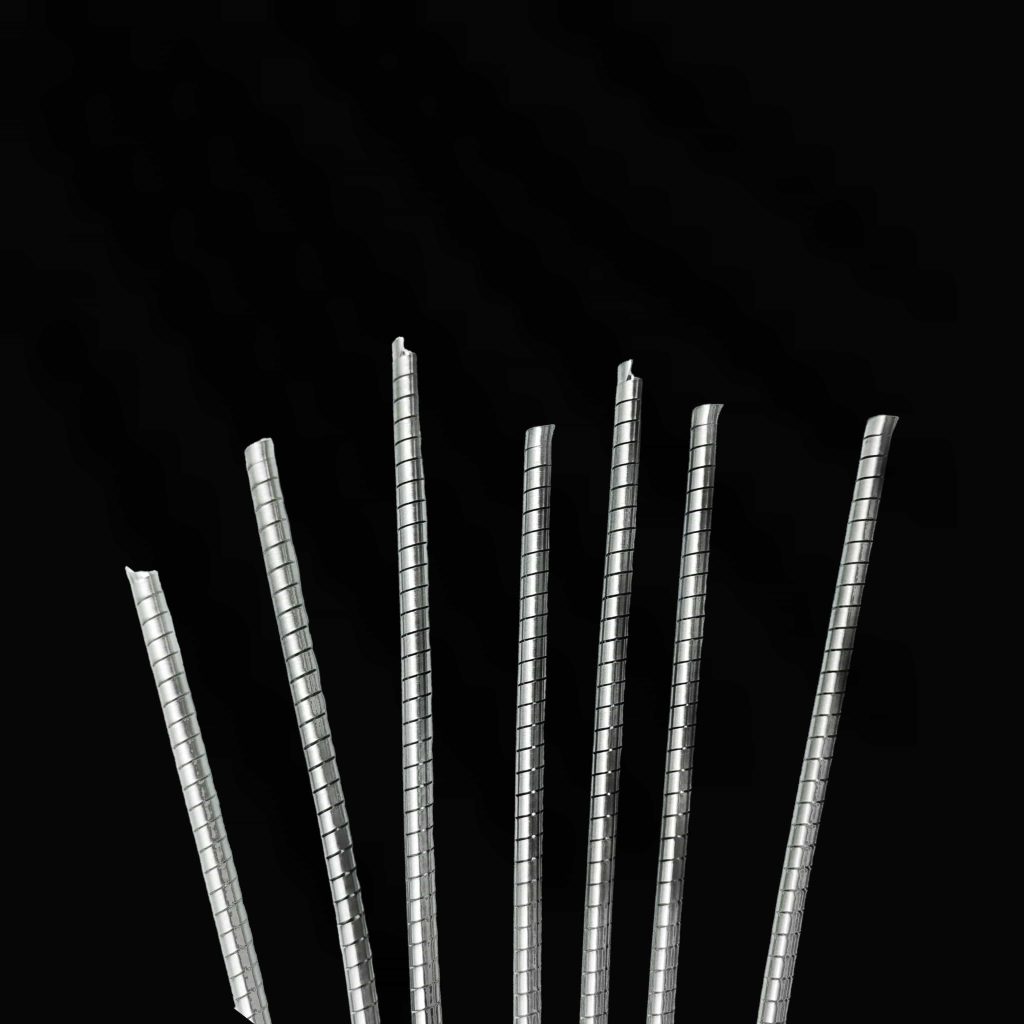
Helical springs are classified by the direction of the primary load they resist:
| Spring Type | Primary Load Direction | Typical Applications |
|---|---|---|
| Compression spring | Axial pushing force | Valves, shock absorbers, push buttons |
| Tension spring (Extension) | Axial pulling force | Garage doors, trampolines, balancing mechanisms |
| Torsion spring | Rotational (torque) force | Clothespins, hinge mechanisms, mouse traps |
Understanding which type fits your application is the first step.
1. Compression Springs – Pushing Force
Compression springs are designed to resist axial compressive loads. When you push on a compression spring, it shortens and stores energy. They are the most common type of helical spring.
Key Characteristics
- Wire spacing: Coils are typically spaced apart (open pitch) to allow compression.
- End types: Closed (squared), ground, or open ends affect how the spring sits in its housing.
- Force behavior: Force increases linearly with deflection (Hooke’s law), unless designed with variable pitch.
When to Choose a Compression Spring
- You need to push a component back to its original position (e.g., valve return)
- You want to absorb shock or vibration (e.g., automotive suspension)
- You require a spring that operates inside a bore or over a rod
- Static or dynamic loading with moderate to high cycle life
Design Parameters for Compression Springs
| Parameter | Symbol | Typical Range / Importance |
|---|---|---|
| Wire diameter | d | 0.1 mm – 20 mm; determines strength |
| Outer diameter | OD | Must fit inside housing |
| Inner diameter | ID | Must clear the rod if used over a shaft |
| Free length | L₀ | Length when uncompressed |
| Solid height | Lₛ | Length when fully compressed (coils touching) |
| Spring rate (stiffness) | k | Force per unit deflection (N/mm or lb/in) |
| Number of active coils | Nₐ | Affects spring rate and stress |
| Material | – | Music wire, stainless steel, Inconel, etc. |
Example Calculation
A compression spring with k = 10 N/mm will produce 100 N of force when compressed 10 mm.
2. Tension Springs (Extension Springs) – Pulling Force
Tension springs are designed to resist axial tensile loads. They have hooks, loops, or threaded ends to attach to components. When you pull on a tension spring, it stretches and stores energy.
Key Characteristics
- Initial tension: Many tension springs are wound with internal preload, requiring a certain force before any deflection occurs.
- End configurations: Machine hooks, cross‑over center loops, extended hooks, or threaded inserts.
- Failure mode: Over‑extension can cause permanent set or hook failure.
When to Choose a Tension Spring
- You need to pull two components together (e.g., counterbalance for a garage door)
- You want to maintain tension in a belt or cable system
- You need a return force that pulls rather than pushes
Key Design Parameters for Tension Springs
| Parameter | Importance |
|---|---|
| Initial tension | Force required to start deflection; must be specified |
| Maximum extension | Should not exceed 50% of free length to avoid over‑stressing |
| Hook strength | Hooks are often the weakest point; design for fatigue |
| Spring rate | Usually lower than compression springs of similar size |
Common Pitfall
Never design a tension spring to operate near its elastic limit. Hooks often fail first due to stress concentration.
3. Torsion Springs – Rotational Force
Torsion springs are designed to resist rotational (torque) loads. The spring legs are twisted around the central axis, and the spring body winds tighter (or unwinds) to produce torque.
Key Characteristics
- Leg orientation: Legs can be straight, bent, or custom‑shaped.
- Wind direction: Right‑hand or left‑hand wound determines torque direction.
- Body diameter: Changes slightly under load (may require clearance).
When to Choose a Torsion Spring
- You need a rotational return force (e.g., hinge, clothespin)
- You want to maintain pressure on a pivot (e.g., brush holder in a motor)
- Space is limited in linear direction but available rotationally
Key Design Parameters for Torsion Springs
| Parameter | Description |
|---|---|
| Torque | Moment produced per degree of deflection (Nm/deg or lb‑in/deg) |
| Mandrel diameter | Rod or shaft that passes through the spring body; must allow for body expansion |
| Leg length | Free leg and loaded leg lengths |
| Stress concentration | Bends at legs create high stress; use large radii where possible |
Example
A torsion spring with torque rate 0.5 N‑m/degree will produce 15 N‑m when deflected 30°.
Choosing the Right Spring Type: Decision Flowchart
Material Selection for Helical Springs
The material determines the spring’s maximum stress, temperature range, corrosion resistance, and cost.
| Material | Max Temp | Corrosion Resistance | Typical Applications |
|---|---|---|---|
| Music wire (ASTM A228) | 120°C | Poor (uncoated) | High‑stress, low‑cost (e.g., toys, instruments) |
| Oil‑tempered wire | 150°C | Fair | Automotive suspensions, clutches |
| Stainless steel 302/304 | 260°C | Good | Food, medical, outdoor |
| Stainless steel 316 | 260°C | Excellent (marine) | Chemical, marine, offshore |
| 17‑7PH stainless | 315°C | Very good | Aerospace, high‑stress |
| Inconel X‑750 | 540°C | Excellent (oxidation) | High‑temperature gas turbines |
| Elgiloy | 400°C | Excellent (sour gas) | Medical, oil & gas |
| Beryllium copper | 200°C | Good (non‑magnetic) | EMI shielding, electrical contacts |
Key Spring Parameters: How They Relate
Spring Rate (k)
The spring rate defines how stiff the spring is.
Formula for compression/tension springs:
k = (G × d⁴) / (8 × D³ × Nₐ)
Where:
- G = shear modulus of material (depends on alloy)
- d = wire diameter
- D = mean coil diameter (OD – d)
- Nₐ = number of active coils
Implication: Small changes in wire diameter (d) have a huge effect because d appears to the fourth power.
Maximum Allowable Stress
To avoid permanent deformation, the maximum operating stress must not exceed the material’s torsional yield strength. For most spring materials, a good rule of thumb is to keep stress below 45% of tensile strength for static applications and below 35% for dynamic (fatigue) applications.
Common Mistakes When Selecting Helical Springs
- Ignoring the spring rate – Choosing a spring that is too stiff or too soft for the available deflection.
- Forgetting about solid height – Compression springs must never be compressed to solid height in normal operation.
- Over‑looking end configurations – A tension spring with weak hooks will fail even if the body is strong.
- Mismatching material to environment – Music wire rusts quickly outdoors; use stainless steel.
- Neglecting fatigue life – High‑cycle applications need stress‑relieved springs and smooth surfaces.
- Not checking for buckling – Long, slender compression springs may buckle sideways under load.
Practical Selection Checklist
Use this checklist when specifying a helical spring:
Step 1 – Define Operating Conditions
- Load direction (push, pull, or rotate)
- Maximum and minimum load
- Available deflection or rotation angle
- Operating temperature range
- Environmental exposure (moisture, chemicals, salt)
- Required cycle life (number of operations)
Step 2 – Estimate Spring Dimensions
- Space available (OD, ID, free length)
- End attachment method (hooks, closed ends, etc.)
Step 3 – Choose Material
- Based on temperature, corrosion, and cost
Step 4 – Calculate Spring Rate
- Required k = load / deflection
Step 5 – Select or Design
- Use manufacturer catalogs for standard springs
- Request custom springs if dimensions or loads are non‑standard
Step 6 – Validate
- Test prototype springs under real conditions
- Check for stress, buckling, and permanent set
Real‑World Example: Semiconductor Handling Equipment
Application: A spring is needed to push a wafer carrier back after a sorting operation. Available space: OD ≤ 12 mm, free length = 30 mm, compressed length at load = 20 mm. Required force at compressed length = 15 N. Ambient temperature 50°C, cleanroom environment (no corrosive gases).
Selection process:
- Type: Compression spring (push)
- Deflection: 30 mm – 20 mm = 10 mm
- Required spring rate: 15 N / 10 mm = 1.5 N/mm
- Material: 304 stainless steel (cleanroom, moderate temp)
- Wire diameter: Estimate using formula or catalog; try d = 0.8 mm, D = 10 mm, Nₐ = 8 → calculate k
- Result: A standard 304 stainless steel compression spring with OD 10 mm, wire 0.8 mm, free length 30 mm, and active coils 8 provides k ≈ 1.5 N/mm.
Where to Find Standard Helical Springs
Most spring manufacturers offer online catalogs with search filters for:
- Spring type (compression, extension, torsion)
- Outer diameter, free length, wire diameter
- Spring rate and maximum load
- Material
For custom springs, provide a drawing with:
- Spring type, material, and surface finish
- OD, ID, free length, wire diameter
- Number of active coils and end configuration
- Load at one or more deflections (or spring rate)
- Operating environment
Conclusion
Selecting the right helical spring doesn’t have to be difficult. Start by identifying the load direction — compression for pushing, tension for pulling, torsion for rotating. Then define your operating conditions, choose the right material, calculate the required spring rate, and check for common pitfalls like solid height or hook failure.
When standard springs won’t fit, custom springs are a practical solution — and with modern manufacturing, custom springs are affordable even in moderate quantities.