Why Canted Coil Springs Extrude in High-Pressure Valves: Causes and Solutions
In high-pressure valves assemblies — especially in oil & gas, aerospace, and industrial hydraulics — canted coil springs are widely used for preload, sealing force, and vibration isolation. These unique spring elements offer linear force characteristics and excellent fatigue resistance. However, when deployed in high-pressure environments, they can sometimes extrude beyond their intended channels, leading to performance loss or catastrophic valve failure.
In this article, we’ll explore the root causes of canted coil spring extrusion in high-pressure valves, diagnose key failure mechanisms, and propose actionable solutions that engineers and maintenance teams can implement.
What Are Canted Coil Springs?
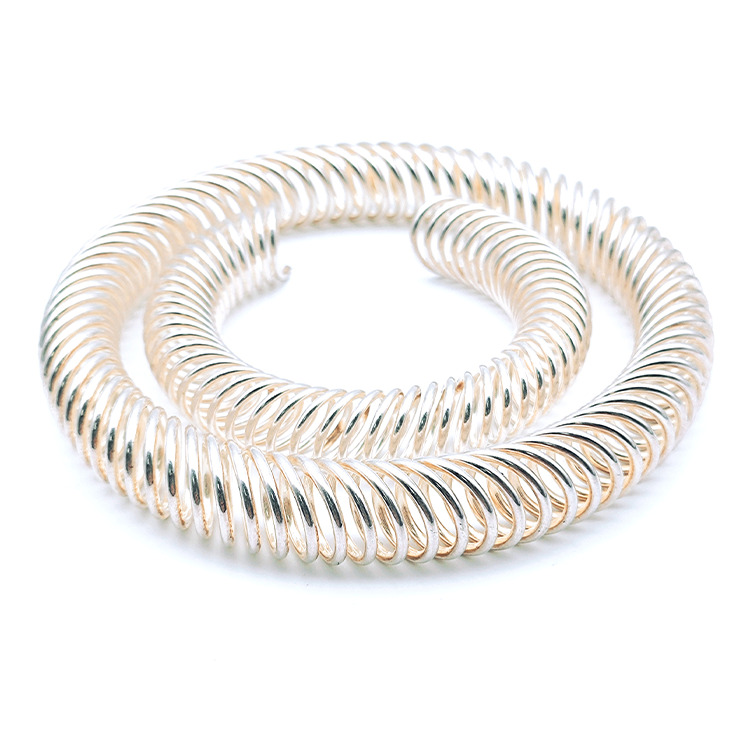
Canted coil springs — also known as bent wire springs or diagonal coil springs — consist of individual coils that are tilted relative to the spring axis. This geometric design enables them to deliver:
- High working stresses with limited solid height
- Consistent force over large deflections
- Excellent fatigue life
- Low height-to-load ratio
They are commonly found in:
- Valve retainers and seals
- Electrical connectors
- Burst disks
- Load-bearing assemblies
Their predictable force-deflection characteristics make them ideal where repeated compression and relaxation occur under load.
The Problem: Extrusion in High-Pressure Valves
Extrusion refers to the unwanted deformation where the canted coil spring material protrudes out of its housing or groove when subjected to internal fluid pressure.
Typical Symptoms
- Spring material visible outside the valve groove
- Loss of preload or inconsistent sealing
- Increased leakage rates
- Reduced service life
- Valve sticking or erratic operation
Understanding why this happens requires looking at both mechanical and fluid-dynamic forces inside the valve assembly.
Root Causes of Spring Extrusion
1. Excessive Differential Pressure
High-pressure valves often operate under extreme fluid pressure gradients.
- Fluid pressure acts radially on the spring, pushing it against the housing.
- When pressure exceeds a critical limit, elastic deformation increases.
- If the groove or chamber is too wide, the spring can be forced out.
💡 Rule of Thumb: As differential pressure increases, the force vector acting on the spring grows proportionally — beyond the containment capacity of the groove.
Figure 1. Reaction of Canted Coil Spring Under Pressure Load
         High-Pressure Fluid ➜
              ↓
      ╔═════════════════════╗
      ║  ┌───────────────┐  ║
      ║  │     Spring    │  ║  ← Force Vector (Pressure × Area)
      ║  └───────────────┘  ║
      ╚═════════════════════╝
  Containment Groove / Channel
2. Housing Geometry and Clearance
Poor design of the spring groove can create unintended clearance.
- Too large groove width → increased likelihood of extrusion
- Inconsistent groove depth → nonuniform spring seating
- Lack of proper sidewalls or retaining features
Table 1. Impact of Groove Geometry on Spring Behavior
| Groove Parameter | Impact on Spring Extrusion |
|---|---|
| Excess width | High likelihood ↑ |
| Insufficient depth | Spring tilt varies ↑ |
| Rounded edges | Spring migration ↑ |
| Non-linear profile | Local stress points ↑ |
3. Material Yield and Creep
The material properties of canted coil springs must withstand both mechanical load and fluid environment.
- Yield strength vs operating stress
- Creep at elevated temperatures and pressures
- Corrosion weakening spring cross-section
If the spring material exceeds its yield point due to load + pressure stress, permanent deformation occurs — making extrusion easier.
4. Dynamic Loading and Fatigue
High-pressure valves don’t just sit under static load — they open and close repeatedly.
- Vibration causes micro-movement between spring and groove
- Repeated cycles degrade contact interfaces
- Work hardening or fatigue cracks reduce containment effectiveness
Preventive Solutions and Best Practices
To reduce or eliminate canted coil spring extrusion, the following design and maintenance strategies are recommended.
✅ 1. Optimal Groove Design
Enhance the groove geometry to match spring characteristics.
- Minimize clearance: Groove width closely matches maximum spring diameter
- Add retainer lips: Physical barriers prevent radial migration
- Tapered walls: Reduce stress concentration at edges
✅ 2. Material Selection & Treatment
Choose spring materials that withstand pressure, temperature, and chemical exposure.
Recommended Materials:
- Stainless steels (17-7 PH, 316 SS)
- Inconel® alloys
- Pre-hardened alloys with corrosion resistance
Heat treatment and surface finishing (e.g., shot peening) can increase fatigue life and reduce creep.
✅ 3. Pressure Balancing and Seals
Reduce net pressure acting on the spring by:
- Using balanced valve designs
- Isolating the spring chamber with pressure-tight seals
- Applying O-rings or backup rings
This approach reduces the magnitude of directional fluid force.
✅ 4. Simulation & Testing
Leverage engineering tools:
Finite Element Analysis (FEA):
- Predict deformation under pressure
- Assess stress concentrations
- Validate groove design before manufacturing
Bench Testing:
- Pressure cycling up to 1.5× operating pressure
- Thermal testing if valve is temperature sensitive
Table 2. Recommended Testing Protocol
| Test Type | Frequency | Goal |
|---|---|---|
| Static Pressure | 1000 cycles | Validate groove containment |
| Dynamic Cycling | 10,000+ cycles | Fatigue and performance |
| Thermal/Humidity | As required | Material behavior assessment |
✅ 5. Routine Maintenance & Inspection
No design is foolproof — periodic checks can catch early warning signs:
- Spring deformation beyond design limits
- Groove wear or scoring
- Leakage patterns
If extrusion is observed early, redesign or spring replacement can prevent system failure.
Case Study Example (Hypothetical)
Background: A high-pressure oil valve (4000 psi) experienced repeated canted coil spring extrusion during field operation.
Diagnosis:
- Groove width 15% larger than spring OD
- Spring material: 17-7 PH not heat-treated
- High operating cycles with elevated temperature
Solution:
- Redesign groove with <2% clearance tolerance
- Add retaining lips
- Switch to Inconel® X-750 with surface peening
Result:
- No extrusion after 12 months
- Improved valve seal performance by 18%
Conclusion
Canted coil spring extrusion in high-pressure valves is a mechanical, geometric, and material challenge — but one that’s highly addressable when engineers apply proper design principles.
Key Takeaways
🔹 Understand the forces at play — high pressures exert radial loads that can drive spring migration.
🔹 Design grooves precisely — tight tolerances and retaining features minimize risk.
🔹 Select materials wisely — fatigue, creep, and corrosion resistance matter.
🔹 Test and validate thoroughly — simulations and real-world cycling reveal hidden issues.
🔹 Maintain proactively — early detection saves costly downtime.
By following these best practices, you not only prevent extrusion but also boost valve reliability, safety, and overall system uptime — which are critical in demanding industrial environments.