Spiral Tube Sizing Guide: Common Mistakes and How to Avoid Them
Learn how to properly size spiral tubes for EMI shielding, sealing, and electrical contact applications. Discover the most common spiral tube sizing mistakes, engineering solutions, material considerations, and expert selection tips to improve reliability and reduce failure risk.
Spiral Tube Sizing Guide: Common Mistakes and How to Avoid Them
Introduction
Spiral Tube products are widely used in EMI shielding, grounding, electrical contact systems, aerospace connectors, medical devices, and precision electronic enclosures. Their flexible spring structure provides reliable conductivity, low compression force, excellent shielding effectiveness, and long service life.
However, many engineers and buyers experience performance failures not because of material quality, but because of incorrect spiral tube sizing.
Improper sizing can lead to:
- Poor EMI shielding performance
- Excessive insertion force
- Electrical instability
- Premature wear
- Compression set
- Assembly difficulty
- Reduced spring life
In high-performance industries such as aerospace, military electronics, semiconductor equipment, and telecommunications, even a small sizing error can cause major reliability problems.
This guide explains the most common spiral tube sizing mistakes, how to avoid them, and how to optimize spiral tube selection for long-term performance.
What Is a Spiral Tube?
A spiral tube is a continuous coiled spring structure typically manufactured from conductive metal wire. It is designed to provide:
- EMI/RFI shielding
- Electrical grounding
- Conductive contact
- Environmental sealing
- Low-force mechanical retention
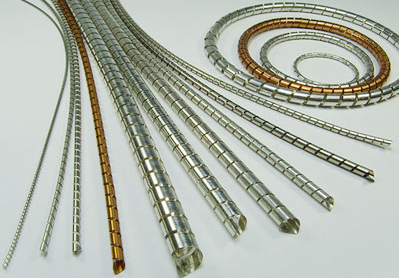
Unlike traditional fingerstock or stamped contacts, spiral tubes offer:
- Multi-point contact
- Uniform compression
- Excellent resilience
- Long cycle life
- Reduced wear
They are commonly installed in grooves, connector interfaces, shielding housings, and mating assemblies.
Why Correct Spiral Tube Sizing Is Critical
Proper sizing directly affects:
| Performance Area | Impact of Incorrect Sizing |
|---|---|
| EMI Shielding | Leakage and signal interference |
| Contact Force | Unstable electrical connection |
| Mechanical Life | Early fatigue failure |
| Assembly | Difficult installation |
| Wear Resistance | Increased friction damage |
| Compression Stability | Permanent deformation |
Even premium materials cannot compensate for poor dimensional selection.
Understanding the Key Spiral Tube Dimensions
Before selecting a spiral tube, engineers must understand the critical sizing parameters.
Main Spiral Tube Dimensions
| Parameter | Description |
|---|---|
| Outer Diameter (OD) | Overall tube diameter |
| Wire Diameter | Thickness of spring wire |
| Pitch | Distance between coil turns |
| Free Height | Uncompressed spring height |
| Compression Ratio | Operating deflection percentage |
| Groove Width | Housing groove dimension |
| Groove Depth | Installation depth |
| Mating Gap | Final compressed gap |
These dimensions determine the tube’s mechanical and electrical behavior.
Common Spiral Tube Sizing Mistakes
Mistake #1: Over-Compression
One of the most common engineering errors is excessive compression.
What Happens?
When the spiral tube is compressed beyond its recommended working range:
- Spring force rises dramatically
- Fatigue life decreases
- Wire deformation occurs
- Contact wear accelerates
- Insertion force becomes excessive
Common Causes
- Groove depth too shallow
- Incorrect mating gap
- Oversized tube selection
- Tolerance stacking errors
Typical Symptoms
| Symptom | Possible Cause |
|---|---|
| Difficult assembly | Excessive compression |
| Permanent deformation | Over-deflection |
| Short service life | Coil stress overload |
Recommended Solution
Maintain compression within the manufacturer’s recommended working deflection range.
Most EMI shielding spiral tubes operate best within controlled compression percentages depending on material and application.
Mistake #2: Under-Compression
Insufficient compression is equally dangerous.
Why It Happens
Engineers sometimes reduce compression force to simplify assembly.
However, low compression reduces:
- Electrical continuity
- Shielding effectiveness
- Grounding reliability
- Mechanical retention
Performance Risks
Under-compressed spiral tubes may cause:
- EMI leakage
- Intermittent electrical contact
- Signal instability
- Vibration sensitivity
Engineering Recommendation
Always verify actual installed compression under production tolerances.
Mistake #3: Ignoring Groove Design
Many engineers focus only on spring dimensions while overlooking groove geometry.
Critical Groove Factors
| Groove Feature | Influence |
|---|---|
| Width | Controls lateral movement |
| Depth | Determines compression |
| Edge Radius | Prevents wire damage |
| Surface Finish | Affects wear and conductivity |
Improper groove design can lead to:
- Uneven compression
- Coil twisting
- Localized wear
- Reduced shielding consistency
Best Practice
Grooves should be precision-machined to ensure uniform compression across the entire spiral tube length.
Mistake #4: Incorrect Material Selection
Material selection is directly connected to sizing performance.
Common Spiral Tube Materials
| Material | Advantages |
|---|---|
| Stainless Steel | Corrosion resistance |
| Beryllium Copper | High conductivity |
| Elgiloy | High-temperature stability |
| Phosphor Bronze | Good spring properties |
Common Material Mistakes
Using soft materials in high-load applications
May cause:
- Compression set
- Force loss
- Short cycle life
Using low-conductivity materials in EMI applications
May reduce:
- Shielding effectiveness
- Ground continuity
Material Selection Should Consider
- Operating temperature
- Compression force
- Environmental exposure
- Electrical requirements
- Mating cycles
Mistake #5: Ignoring Tolerance Stack-Up
Prototype performance often differs from mass production because of tolerance variation.
Common Problem
Engineers may size the spiral tube using nominal dimensions only.
Actual production variation may include:
- Groove machining tolerance
- Housing distortion
- Surface coating thickness
- Spring manufacturing variation
Result
Compression may become:
- Too high
- Too low
- Uneven across the assembly
Recommended Solution
Perform full tolerance analysis before finalizing the design.
Mistake #6: Failing to Account for Thermal Expansion
Temperature changes significantly affect spiral tube performance.
High-Temperature Risks
At elevated temperatures:
- Metal expansion changes compression
- Spring force decreases
- Stress relaxation increases
Low-Temperature Risks
At cryogenic temperatures:
- Materials may become brittle
- Contact force behavior changes
Best Practice
Always evaluate installed compression across the entire operating temperature range.
Mistake #7: Choosing the Wrong Wire Diameter
Wire diameter strongly influences:
- Spring force
- EMI performance
- Fatigue resistance
- Compression behavior
Oversized Wire Problems
- Excessive insertion force
- Difficult assembly
- High wear
Undersized Wire Problems
- Weak contact force
- Poor shielding
- Reduced durability
Engineering Recommendation
Wire diameter should match:
- Required contact force
- Space limitations
- Shielding performance targets
- Mechanical cycle requirements
Spiral Tube Sizing Best Practices
Recommended Design Workflow
1. Define Application Requirements
Determine:
- EMI level
- Electrical conductivity
- Compression space
- Environmental conditions
- Mechanical cycling
2. Calculate Working Compression
Proper compression is the foundation of reliable performance.
Compression affects:
- Contact force
- Shielding effectiveness
- Fatigue life
3. Optimize Groove Geometry
Ensure groove design supports:
- Uniform loading
- Easy installation
- Long-term stability
4. Select Proper Material and Plating
Common plating options include:
- Silver
- Nickel
- Gold
- Tin
Different plating systems affect:
- Conductivity
- Corrosion resistance
- Wear life
5. Validate with Prototype Testing
Always verify:
- Compression behavior
- Contact resistance
- EMI shielding effectiveness
- Cycle durability
Spiral Tube Applications
Spiral Tube products are widely used in:
| Industry | Application |
|---|---|
| Aerospace | Avionics shielding |
| Medical | Diagnostic equipment |
| Telecommunications | RF enclosures |
| Semiconductor | Precision equipment grounding |
| Military Electronics | EMI protection |
| Automotive | EV battery shielding |
How to Improve Spiral Tube Reliability
Key Engineering Recommendations
Use Accurate Compression Calculations
Avoid relying on estimated dimensions.
Validate Real Assembly Conditions
Test under:
- Temperature cycling
- Vibration
- Environmental exposure
- Repeated mating cycles
Work with Experienced Manufacturers
Custom spiral tube suppliers can help optimize:
- Compression range
- Groove dimensions
- Material selection
- Shielding performance
Why Custom Spiral Tube Design Matters
Standard products do not always fit complex assemblies.
Custom spiral tube solutions provide:
- Optimized force
- Better EMI performance
- Improved installation
- Longer service life
Custom engineering support may include:
- Groove design assistance
- Compression analysis
- Material recommendations
- Prototype testing
- EMI validation
Request Engineering Support for Your Application
Looking for a reliable Spiral Tube manufacturer for EMI shielding or electrical contact applications?
Our engineering team can provide:
- Custom spiral tube sizing
- Material recommendations
- Groove design support
- EMI shielding optimization
- Prototype samples
- Technical drawings
- Fast quotation support
Send your drawings or application requirements today for professional engineering evaluation and customized spiral tube solutions.
Conclusion
Proper spiral tube sizing is essential for reliable EMI shielding, electrical conductivity, and long-term mechanical performance. Most failures are caused not by poor materials, but by incorrect compression, improper groove design, tolerance errors, or unrealistic operating assumptions.
By understanding the most common sizing mistakes and following proven engineering practices, manufacturers and design engineers can significantly improve reliability, reduce field failures, and optimize product performance.
A properly sized Spiral Tube delivers stable conductivity, excellent shielding effectiveness, low wear,and long service life across demanding industrial applications.