캔트 코일 스프링으로 EMI 차폐 성능이 떨어지는 이유

중국 후난성 천저우시

Discover the engineering causes behind EMI shielding failure in canted coil springs—including loss of deflection, inconsistent contact force, and material relaxation. Learn proven design strategies to maintain shielding effectiveness.

캔트 코일 스프링 are widely used in EMI shielding applications—from medical devices and aerospace connectors to semiconductor equipment and telecommunications infrastructure . Their unique angled coil geometry allows them to close design gaps where the skin effect would otherwise create electrical dipoles that break through the surrounding shielding material .

EMI SHIELDING canted coil spring

But what happens when shielding performance degrades?

When an EMI gasket fails, the consequences can be severe: signal instability, electromagnetic leakage, certification failure, and system downtime . Understanding  shielding performance fails is essential for engineers designing high-reliability systems.

This article explores the root causes of EMI shielding failure in canted coil springs, the engineering mechanisms behind each failure mode, and proven strategies to ensure long-term shielding effectiveness.


1. How Canted Coil Springs Provide EMI Shielding

Before examining failure modes, it’s important to understand how canted coil springs function as EMI shielding elements.

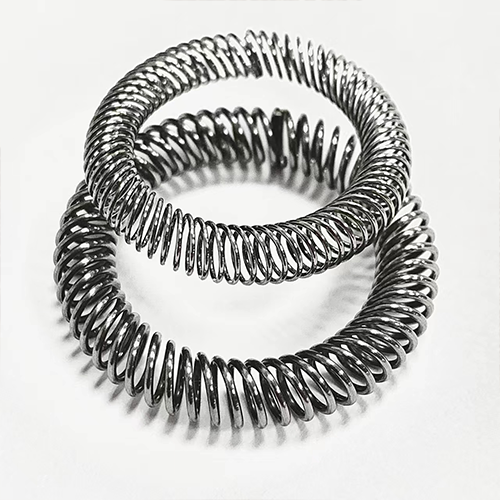
Canted coil springs—also called slanted coil springs or spiral spring EMI shielding rings—are helical geometries whose ends are circularly joined to form a torus . When installed in a groove between mating surfaces, the spring creates multiple points of electrical contact along its length.

The shielding mechanism works as follows:

  • Design gap closure: The spring physically bridges gaps between conductive surfaces, preventing the formation of electrical dipoles that would allow EMI penetration .
  • Electrical continuity: The metallic spring provides a low-impedance path for interfering signals to be conducted to ground.
  • Multi-point contact: Unlike flat gaskets, canted coil springs maintain contact at multiple discrete points, ensuring consistent shielding even with surface irregularities.

For effective EMI shielding, the spring must maintain:

  • Sufficient contact force against mating surfaces
  • Electrical conductivity at each contact point
  • Stable mechanical engagement over time

When any of these conditions degrade, shielding performance suffers.


2. Primary Causes of EMI Shielding Failure

Based on engineering analysis of canted coil spring failures, shielding degradation typically results from one or more of the following mechanisms:

2.1 Loss of Deflection (Insufficient Compression Stroke)

What it is: Loss of deflection occurs when a canted coil spring cannot achieve the required compression stroke or exhibits reduced restoring force after compression .

How it affects EMI shielding: When the spring loses deflection, it fails to maintain adequate contact force against mating surfaces. This creates gaps in the conductive path, allowing EMI leakage. In EMI spiral spring shielding rings, constant compression combined with temperature cycling can lead to shielding gaps appearing over time .

일반적인 증상:

  • Reduced EMI shielding effectiveness
  • Intermittent electrical continuity
  • Signal instability
  • Certification test failures 

Root causes:

CauseDescription
과도한 압축Compression exceeding 30% of free height pushes the spring beyond its elastic limit 
머티리얼 크립Gradual deformation under sustained load, especially at elevated temperatures 
FatigueHigh-cycle repetition (10,000–100,000 cycles) leads to gradual force reduction 
부적절한 그루브 형상Groove too narrow causes coil confinement; groove too deep prevents proper engagement 

2.2 Inconsistent Contact Force

What it is: Contact force refers to the normal force exerted by the spring against mating conductive surfaces. When this force becomes inconsistent—either over time or across different assemblies—shielding performance becomes unpredictable .

How it affects EMI shielding: For effective EMI gasketing, the spring must maintain stable, distributed contact pressure. Inconsistent force leads to:

  • Uneven current distribution
  • Localized gaps in the conductive path
  • Variable transfer impedance
  • Unpredictable shielding effectiveness 

Root causes:

  • Stress relaxation: Gradual loss of stored elastic energy under sustained compression 
  • 머티리얼 크립: Slow permanent deformation under constant load, particularly at elevated temperatures 
  • Manufacturing tolerances: Dimensional variations in wire diameter, coil pitch, or free height 
  • Assembly-induced variability: Misaligned grooves, over-compression during installation 

2.3 Material Relaxation and Creep

What it is: Stress relaxation and material creep are time-dependent phenomena where metals gradually lose stored elastic energy or deform permanently under sustained load .

How it affects EMI shielding: For EMI applications, even a 10–20% drop in contact force can be enough to compromise electrical conductivity . When the spring no longer exerts adequate pressure against mating surfaces, contact resistance increases and shielding effectiveness declines.

Temperature effects: Temperature dramatically accelerates both relaxation and creep. General guidelines show:

  • 100°C 이하 → 최소한의 휴식
  • 100-150°C → 적당한 이완
  • 150°C 이상 → 빠른 힘 붕괴(스테인리스강의 경우) 

Material comparison: Different alloys exhibit dramatically different relaxation behavior:

재료Force Loss After 1000 Hours @150°C
302 스테인리스 스틸20-30% 
316 스테인리스 스틸15-25% 
베릴륨 구리8-15% 
엘길로이®<8% 
인코넬 X-750<5% 
MP35N<5% 

2.4 Electrical Contact Failure

For EMI shielding and grounding applications, a canted coil spring may fail electrically even if it remains mechanically intact .

Root causes:

  • Oxidation of contact surfaces: Corrosion or oxidation creates insulating layers that increase contact resistance
  • Insufficient contact force: When force drops below a threshold, the spring cannot penetrate surface oxides
  • Contamination at contact points: Particulates or films at the contact interface
  • Fretting corrosion: Micro-motion at contact points can accelerate surface degradation 

2.5 Improper Groove Design

Groove geometry is often overlooked but critically affects EMI shielding performance. Improper groove design can cause shielding failure even with a perfectly manufactured spring .

Common groove design errors:

ErrorEffect
Insufficient groove depthUneven coil engagement, localized overstress 
과도한 방사형 간격Coil rotation, unpredictable force distribution 
날카로운 모서리Coil damage, stress concentration 
Rough surface finishIncreased friction, uneven loading 
비평행 측벽Uneven load distribution 

Poor groove design can reduce spring life by more than 40% .


3. The Mechanical-to-Electrical Failure Chain

To visualize how mechanical degradation leads to EMI shielding failure, consider the following failure chain:

Each stage in this chain represents an opportunity for intervention and prevention.


4. Engineering Solutions to Maintain Shielding Performance

The good news: EMI shielding failure in canted coil springs is not random—it is the direct result of identifiable engineering factors . By addressing these root causes, engineers can achieve stable, long-term shielding performance.

4.1 Select the Right Material

Material selection is the single most effective way to prevent force relaxation and maintain EMI shielding performance .

Material selection guide for EMI applications:

Application RequirementRecommended Material
High-cycle EMI shielding엘길로이® 
High-temperature environmentsInconel X-750 / 718 
General EMI/grounding17-7PH 
부식성 환경316L 스테인리스 스틸 
High electrical conductivity베릴륨 구리 

Upgrading material alone can improve force retention by up to 50% .

4.2 Optimize Groove Design

Proper groove geometry ensures uniform coil engagement and prevents localized stress .

Recommended groove design guidelines:

  • 그루브 깊이 = 와이어 직경 × 0.85-0.95 
  • 모서리 반경 ≥ 0.2mm 
  • 방사형 간격 제어
  • 평행 홈 벽
  • Smooth surface finish (Ra ≤ 0.8 μm) 

Groove issue troubleshooting:

IssueEffect솔루션
Too narrowCoil confinementIncrease width 
Too deepLimited strokeReduce depth 
Incorrect diameterUnintended preloadAdjust tolerance 
날카로운 모서리Stress concentrationAdd radius 

4.3 Control Operating Deflection

Canted coil springs are designed to operate within a specific deflection range. Exceeding this range can cause plastic deformation and permanent force loss .

Design rules:

  • Keep working deflection within 20-30% of free height 
  • Never exceed 80% of maximum compression 
  • Add mechanical stops to limit maximum compression 
  • Define initial preload and target force range, not just deflection 

4.4 Apply Conductive Platings

For EMI applications, surface treatments are often essential to maintain low contact resistance .

Common platings for EMI shielding:

  • 실버: Highest conductivity, good oxidation resistance
  • 골드: Excellent corrosion resistance, ideal for critical applications
  • Tin: Cost-effective, good for general use
  • 니켈: Often used as an underlayer

Platings serve multiple functions:

  • Prevent oxidation of contact surfaces
  • Reduce contact resistance
  • Ensure galvanic compatibility with mating materials

4.5 Validate with Testing

Professional validation ensures that springs will maintain shielding performance throughout their service life .

Recommended tests for EMI applications:

  • 하중-변형 곡선 측정
  • Permanent set testing
  • Thermal aging tests
  • High-cycle fatigue testing
  • EMI shielding effectiveness tests 

5. Comparison: Spring Types and EMI Suitability

Different spring types exhibit varying suitability for EMI shielding applications:

스프링 유형포스 안정성편향 범위이완 저항EMI Suitability
압축 스프링낮음좁은보통Poor
웨이브 스프링보통보통보통제한적
리프 스프링보통제한적보통제한적
캔트 코일 스프링높음와이드우수우수 

Properly engineered canted coil springs outperform traditional springs in long-term force stability—a critical requirement for reliable EMI shielding .


6. Case Study: Shielding Failure in Medical Devices

Scenario: A medical device manufacturer experienced intermittent EMI 차폐 failures during certification testing. After several weeks of operation, shielding effectiveness dropped below required levels.

진단: Analysis revealed that the canted coil springs in the device’s EMI gaskets had experienced loss of deflection due to :

  • Constant compression during storage
  • Temperature cycling during operation
  • Material relaxation in standard stainless steel

솔루션: The manufacturer :

  • Upgraded to Elgiloy® springs for better relaxation resistance
  • Optimized groove geometry to ensure uniform load distribution
  • Implemented controlled compression limits during assembly

결과: Shielding performance remained stable throughout the device’s service life, and certification tests passed consistently.


Conclusion: Preventing EMI Shielding Failure

EMI shielding failure in canted coil springs is not inevitable—it is an engineering challenge with clear solutions .

The primary contributors to shielding degradation include:

  • Loss of deflection from over-compression or fatigue 
  • Inconsistent contact force due to stress relaxation and creep 
  • Material limitations at elevated temperatures 
  • Improper groove design causing uneven loading 
  • Electrical contact degradation from oxidation or contamination 

엔지니어는 적절한 재료 선택, 정밀한 홈 설계, 제어된 작업 범위, 전문적인 제조 공정을 적용함으로써 다음과 같은 성과를 달성할 수 있습니다:

✅ Stable EMI shielding effectiveness
✅ Reliable electrical contact
✅ Consistent mechanical performance
✅ 서비스 수명 연장
✅ 현장 장애 감소 

For high-reliability EMI applications in medical, aerospace, semiconductor, or telecommunications systems, canted coil springs—when correctly specified and applied—provide exceptional long-term shielding performance.

견적 요청하기