6 most common problems-EMI shielding Canted Coil Spring Installation Problems and How to Avoid Them
Meta Description:
Are installation issues compromising your canted coil spring performance? Discover the 6 most common problems—from incorrect groove design to coil binding—and learn practical solutions to ensure reliability and extend service life.
Canted coil springs (also known as slanted coil springs) are engineered marvels used in demanding applications ranging from aerospace connectors and medical devices to EMI shielding and downhole oil tools . Their unique canted design allows for consistent force over a wide deflection range, uniform load distribution, and excellent performance in both sealing and electrical connectivity .
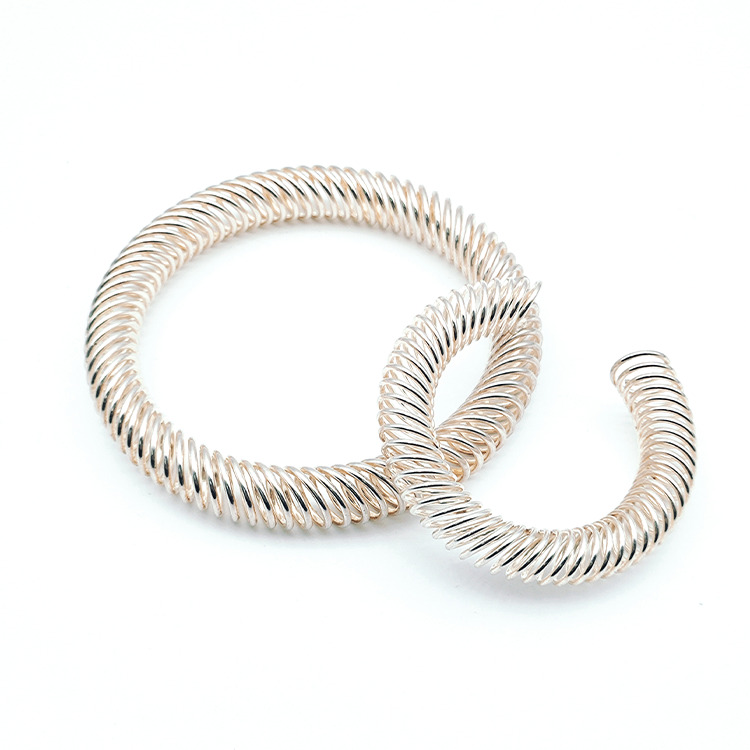
However, even the highest quality spring will fail prematurely if the installation environment—specifically the groove design—is mishandled. In fact, groove-related issues are among the most common causes of spring failure, leading to inconsistent load, coil binding, or complete spring dislodgement .
This article walks you through the most frequent installation problems and provides actionable solutions to ensure your canted coil springs perform optimally.
Why Installation Precision Matters
Unlike standard compression springs, canted coil springs rely on a precise interaction between the coil and its housing groove. The groove is not just a container; it is a functional partner that dictates how the spring deflects, how much load it carries, and how long it lasts. A poor installation environment negates the mechanical advantages of the spring, causing issues like uneven stress, extrusion, or accelerated wear .
Below is a breakdown of the most common installation problems and how to solve them.
1. Incorrect Groove Dimensions
The most frequent installation errors stem from the groove that houses the spring. Because the spring’s performance is directly tied to its mechanical envelope, getting the groove right is the first step to a successful installation.
The Problem:
- Groove too narrow: Restricts the spring’s natural deflection. This causes coil binding, where the coils compress into each other unevenly, leading to high stress concentrations and early fatigue failure .
- Groove too wide: Allows excessive lateral movement. The spring may shift, roll, or even dislodge from the groove during dynamic operation, resulting in loss of retention or sealing pressure .
- Incorrect Depth: If the groove is too shallow, the spring lacks room to deflect. If it is too deep, the spring may over-deflect beyond its elastic limit, causing permanent set (deformation) and loss of force .
The Solution:
Always match the groove dimensions precisely to the spring manufacturer’s specifications. The width should allow controlled movement without excessive play, and the depth must accommodate the working deflection range without permitting over-compression .
2. Sharp Edges and Poor Surface Finish
The Problem:
Sharp corners at the edge of the groove act as cutting tools. As the spring compresses and expands—especially in dynamic or high-vibration environments—the coils rub against these sharp edges. This leads to abrasion, increased friction, and micro-cutting of the wire, which drastically reduces fatigue life . A rough surface finish accelerates this wear process.
The Solution:
Specify chamfered or radiused edges on the groove opening. Ensure a smooth surface finish on the groove walls and mating surfaces to reduce friction and wear . This is particularly critical in high-cycle applications.
3. Contamination and Debris
The Problem:
Canted coil springs are often used in sealing applications where they must seat perfectly against a mating surface. If the shaft or housing is contaminated with dust, machining chips, or old lubricants, the spring cannot seat properly. This creates leak paths in fluid seals or intermittent connectivity in electrical applications .
The Solution:
Clean the shaft surface and groove thoroughly before installation. Ensure the area is free of dust, debris, and old residue. In clean-room applications (medical or semiconductor), follow strict protocols to prevent particulate contamination .
4. Misalignment During Assembly
The Problem:
During installation, if the spring is twisted or if the mating component is inserted at an angle, the spring can become eccentrically loaded. This causes uneven compression, where one side of the spring is fully compressed while the other side is loose. This leads to inconsistent force distribution and can damage the sealing lip or the spring itself .
The Solution:
Align the seal and spring with the centerline of the shaft or bore during installation. Use assembly guides or mandrels to ensure the mating part enters straight. Apply pressure evenly and gradually to “seat” the spring uniformly .
5. Ignoring the Operating Environment in Groove Design
The Problem:
Engineers sometimes design the groove based on nominal room-temperature dimensions, forgetting that the assembly will face extreme heat or cold. Thermal expansion can close the gap intended for the spring, effectively making the groove too narrow and causing coil binding. Conversely, swelling from chemical exposure or corrosion can lock the spring in place .
The Solution:
Design the groove and select clearances based on the actual operating conditions. Account for the Coefficient of Thermal Expansion (CTE) of both the housing material and the spring material (often Inconel or stainless steel) to ensure the spring has the correct working volume at operating temperature .
6. Tolerance Stack-Up
The Problem:
Even if your individual groove drawing is perfect, manufacturing tolerances on the housing, the gland, and the spring itself can add up (stack) to create an assembly that is out of spec. One part might be at its maximum tolerance while another is at its minimum, leading to unpredictable preload or instability .
The Solution:
Perform a tolerance stack-up analysis during the design phase. Communicate with your spring manufacturer about the acceptable range of forces and deflections so they can recommend a spring design that accommodates real-world manufacturing variability .
Best Practices for a Successful Installation
To summarize, here is a quick reference chart to diagnose and prevent installation issues:
Conclusion
Canted coil springs are highly reliable components, but they demand respect for their mechanical interface. By avoiding common pitfalls like incorrect groove dimensions, sharp edges, and improper alignment, you can significantly extend the service life of your springs and ensure the reliability of your overall system .
When in doubt, collaborate with your spring manufacturer early in the design process. Their expertise in groove optimization and material selection is invaluable for avoiding costly redesigns and field failures .