How to Choose the Right Spiral Tube for EMI Shielding: A Complete Selection Guide

中国湖南省郴州市

Learn how to choose the right EMI shielding spiral tube for your application. This complete guide covers shielding effectiveness, material options (beryllium copper, stainless steel, Hastelloy), compression force, groove design, and selection criteria for semiconductor, medical, and telecom equipment.

Introduction: Why the Right Spiral Tube Matters

Electromagnetic interference is no longer a niche concern. From semiconductor wafer fabs and medical imaging suites to telecom base stations and military avionics, EMI can corrupt signals, degrade performance, and even cause system failures. The shielding gasket you choose sits at the seam of your enclosure—the single most vulnerable point for EMI leakage.

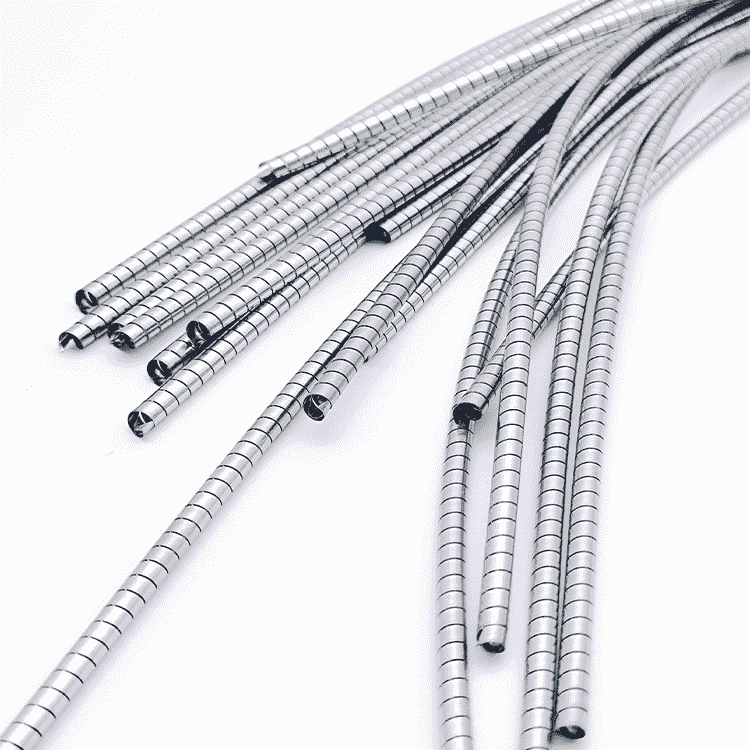
Among all shielding solutions, the スパイラルチューブ (also called spiral shield gasket or metal spiral EMI gasket) stands out. Its unique helical winding structure provides multiple points of continuous electrical contact, creating a robust Faraday cage effect across seams, doors, and removable panels. But with multiple material options, force ratings, and installation variables, how do you choose the right one?

真空装置用電磁シールドスパイラルチューブ-Handashielding

This guide walks you through a systematic selection process—from defining your application requirements to final validation.


Step 1: Define Your Application Requirements

Before evaluating any product specifications, you must clearly define your operating environment. The wrong material in the wrong environment will fail—often catastrophically.

Key Questions to Answer

考察What to Ask
Shielding NeedWhat frequencies need attenuation? 1 MHz? 10 GHz?
Shielding Effectiveness TargetWhat dB level is required? 60 dB? 100 dB? 165 dB?
温度範囲What are the min/max operating temperatures?
Corrosive ExposureWill the gasket contact chlorides (marine), acids (chemical plants), or moisture?
Compression CyclesIs the enclosure opened frequently (high cycle) or rarely (static)?
Closure ForceDoes the design require low closure force?
Galvanic CompatibilityWhat metal is the mating enclosure (aluminum, steel, etc.)?
Environmental Seal NeededMust the gasket also block dust, moisture, or liquids?

The “60–120 dB Rule”

Most commercial equipment requires shielding effectiveness between 60 and 120 dB. General industrial applications often target 60–100 dB, while aerospace, military, and medical equipment may demand 100 dB or higher. High-end spiral tubes can achieve up to 165 dB—far beyond standard requirements.


Step 2: Understand the Key Performance Metrics

2.1 Shielding Effectiveness (SE)

Shielding effectiveness measures how much electromagnetic energy the gasket attenuates, expressed in decibels (dB). Higher dB means better shielding.

SE LevelAttenuationTypical Application
60 dB99.9%Commercial electronics, general industrial
100 dB99.99999%Aerospace, military, medical devices
165 dB~99.99999999999997%Semiconductor equipment, mission-critical systems

Spiral tubes typically deliver 86–165 dB depending on design and material. The shielding quality may vary with frequency, with peak performance often at lower frequencies like 1 GHz.

2.2 Compression Force and Resilience

Spiral tubes are available in different force ratings to match your closure force requirements.

Force Series Overview:

Force SeriesCompression Force (OD 3.2mm, 25% comp)典型的な使用例
Standard Force (S Series)~4.8 ±15% Kgf/inGeneral industrial, balanced performance
Medium Force (M Series)~2.0 ±15% Kgf/inModerate sealing pressure
Low Force (L Series)~0.4 ±15% Kgf/inPrecision equipment, sensitive applications

Data sources:

Important: For standard spiral tubes (cordless), the spring force is primarily a function of strip thickness—the force is proportional to the cube of the thickness. For designs requiring higher compression force with better over-compression protection, inner cord (core) options such as solid silicone, silicone tube, or silicone foam are available.

2.3 Optimal Compression

The recommended compression for spiral tubes is 25% of the spiral diameter. Operating outside this range degrades performance:

  • Under-compression: Insufficient contact force, reduced SE, potential leakage
  • 過圧縮: Risk of permanent damage to the spiral structure

If your application involves risk of over-compression (e.g., variable gap sizes, thermal expansion), selecting a spiral tube with an inner silicone core prevents crushing damage.


Step 3: Select the Right Material

Material selection is the most critical decision in the spiral tube selection process. The table below summarizes the four primary material families.

素材主要物件Best Environmentシールド効果
ベリリウム銅High conductivity (17–28% IACS), excellent spring properties, good corrosion resistanceGeneral EMI shielding, electrical contact applications60-100 dB
ステンレス鋼High strength, corrosion resistance, cost-effectiveDry/indoor environments, cost-sensitive applications60-100 dB
Hastelloy C‑276Superior resistance to pitting, crevice corrosion, and stress corrosion crackingHarsh chemical, marine, sour gas, high-temperature60-100 dB
Titanium (TA1/TC4)High strength-to-weight, excellent corrosion resistance, biocompatibleMedical implants, aerospace, chemical processing60-100 dB

3.1 Beryllium Copper: The All-Rounder

Tin- or nickel-plated beryllium copper (BeCu) is the most common material for spiral tubes. It offers:

  • High electrical conductivity (17–28% IACS)
  • Excellent spring properties for repeated compression cycles
  • 良好な耐食性
  • Plating options for galvanic compatibility

When tin-plated BeCu contacts aluminum in saline environments, the tin layer provides excellent galvanic corrosion protection.

3.2 Stainless Steel: Cost-Effective Corrosion Protection

Stainless steel spiral tubes are used when corrosion protection is the primary concern and conductive properties are less critical.

301ステンレス鋼: High strength, cost-effective for consumer electronics and robotics; moderate corrosion resistance suitable for indoor/dry environments.

304ステンレス鋼: Superior corrosion resistance for food/medical applications; good weldability; non-magnetic when annealed.

316ステンレス鋼: Enhanced corrosion resistance with molybdenum for marine/offshore environments; operating temperature -200°C to +800°C; excellent for pharmaceutical cleanrooms and nuclear applications.

17-7PH: Precipitation-hardened alloy with high strength-to-weight ratio; ideal for military antenna shielding (MIL-STD-461 compliance) and oil/gas downhole sensors.

3.3 Hastelloy C‑276: Extreme Environments

For semiconductor equipment exposed to aggressive chemical gases (CVD processes, plasma etching), high-temperature environments, or severe corrosion conditions, Hastelloy spiral gaskets are the premium choice.

主な特性

  • Resistant to pitting, crevice corrosion, and stress corrosion cracking
  • Maintains strength at elevated temperatures
  • Nickel-molybdenum-chromium composition (Ni balance, Mo 15–17%, Cr 14.5–16.5%)

3.4 Titanium: Lightweight and Biocompatible

Titanium spiral tubes (TA1/TC4) offer:

  • 高い強度対重量比
  • 優れた耐食性
  • Biocompatibility for medical applications
  • 良好な高温特性

Ideal for medical implants, aerospace components, and applications requiring weight reduction without sacrificing corrosion resistance.


Step 4: Choose the Right Core (Inner Cord) Option

Spiral tubes are available with or without inner cord (core). The core serves multiple functions: it prevents over-compression damage, adds environmental sealing, and increases compression force.

Core TypeCode特徴圧縮力
No Inner CordWLowest cost, most flexibleBaseline
シリコーン・フォームFSoft, good for low compression force applicationsModerate increase
Silicone TubeTHollow core, balanced performanceMedium increase
Silicone SolidAHighest compression force, best over-compression protectionHighest increase

Data sources:

Selection guidance:

  • If over-compression is not a concern: Cordless design (Code W) offers the best quality/price ratio and is recommended for most applications
  • If handling/installation may cause compression problems: Select silicone foam (F) or silicone tube (T) cores
  • If the application requires both EMI shielding and environmental sealing: Select solid silicone (A) core—particularly important for outdoor or high-humidity applications

Step 5: Verify Galvanic Compatibility

When two dissimilar metals contact in the presence of an electrolyte (moisture, salt, chemicals), galvanic corrosion occurs. The more active metal corrodes at an accelerated rate.

: Aluminum enclosures are common. If an unplated stainless steel spiral tube contacts aluminum in a humid environment, the aluminum will corrode rapidly.

Solutions:

  • Choose plating that matches the housing metal: tin and nickel plating on BeCu offer excellent corrosion protection when contacting aluminum in saline environments
  • Alternatively, select a material closer on the galvanic series to the mating metal

General guidance:

  • For aluminum housings: Use tin-plated or nickel-plated beryllium copper
  • For steel housings: Stainless steel is generally compatible
  • For marine/offshore environments: Use Hastelloy or properly plated BeCu

Step 6: Design the Mounting Groove

Proper groove design is critical for optimal spiral tube performance. Follow these recommended guidelines:

Standard O-Ring Groove Mounting

Spiral tubes are designed to be mounted in a standard O-ring groove.

Key dimensions:

パラメータRecommended ValueSource
Groove Depth75% of spiral diameter
Groove WidthAt least 35% wider than gasket diameter

: For a 3.2 mm OD spiral tube:

  • Groove depth ≈ 2.4 mm
  • Groove width ≈ 4.32 mm minimum

The groove must be clean, free of burrs, and have smooth surfaces to prevent damage to the spiral structure during installation and operation.


Step 7: Match the Spiral Tube to Your Industry

半導体製造装置

Semiconductor manufacturing equipment (plasma etching, CVD, deposition tools) faces unique challenges: aggressive process gases, high vacuum requirements, and high-temperature bake-out cycles.

Recommended configuration:

  • 素材: Hastelloy C‑276 for chemical gas exposure, 316 stainless steel for less aggressive environments
  • Core: Silicone solid for vacuum integrity
  • フォース: Standard or medium
  • Shielding requirement: Up to 165 dB

Why: Hastelloy resists pitting and stress corrosion cracking in aggressive chemical gases; silicone core maintains vacuum seal; high SE protects sensitive wafer processing.

医療機器

Medical equipment (MRI, patient monitors, surgical instruments) requires reliable EMI shielding to prevent interference with sensitive physiological signal detection (ECG signals as low as 1–2 mV, EEG signals as low as 5–100 μV).

Recommended configuration:

  • 素材: 304/316 stainless steel or tin-plated beryllium copper
  • Core: Silicone solid for environmental sealing
  • フォース: Low to medium (precision equipment)
  • Compliance: FDA, IEC 60601-1-2, YY 0505-2012

Why: Medical environments require sterilization compatibility and long-term stability (8–10 years); stainless steel offers excellent biocompatibility and corrosion resistance; silicone core prevents moisture ingress.

Telecommunications and Data Centers

Telecom equipment and data center servers require high-density EMI protection with minimal closure force.

Recommended configuration:

  • 素材: Tin-plated beryllium copper or 301 stainless steel
  • Core: No inner cord (cordless) for cost efficiency
  • フォース: Low to medium

Why: High-density enclosures require low closure force to prevent damage to sensitive components; cordless design reduces cost when over-compression is not a concern.

航空宇宙・防衛

Aerospace applications demand the highest reliability under extreme conditions: vibration, wide temperature swings, salt fog, and high-altitude pressure changes.

Recommended configuration:

  • 素材: 316 stainless steel, Hastelloy, or titanium
  • Core: Silicone solid for environmental seal
  • フォース: Standard or medium
  • Compliance: MIL-STD-461, MIL-STD-810

Why: 316 stainless steel resists salt fog per MIL-STD-810; high reliability under cyclic stress; titanium offers weight reduction where critical.


Step 8: Common Selection Mistakes to Avoid

MistakeConsequence予防
Ignoring galvanic compatibilityRapid corrosion at contact interfaceVerify material compatibility; use appropriate plating
Selecting wrong force ratingUnder-compression (reduced SE) or over-compression (damage)Calculate required closure force before selection
Neglecting core selectionOver-compression damage in variable-gap applicationsSelect appropriate core if gap variation is significant
不適切な溝設計Poor seating, reduced SE, gasket damageFollow recommended groove depth and width guidelines
Over-specifying materialUnnecessary costMatch material to actual environment, not worst-case
Under-specifying materialPremature failure in harsh environmentTest material samples in actual operating conditions

Step 9: Quick Selection Flowchart


Step 10: Ordering Guide

When ordering spiral tube gaskets, specify the following parameters using a standardized part numbering system:

パラメータCode Options
フォースS (Standard), M (Medium), L (Low)S
素材B (BeCu), BS (Sn-plated BeCu), BN (Ni-plated BeCu), SN (SS), HA (Hastelloy)BN
Outer Diameter (OD)008–120 (0.8–12.0 mm)086 (0.86 mm)
CoreW (none), A (solid), T (tube), F (foam)A

HDS-SBN-086A = Standard Force, Ni-plated BeCu, 0.86 mm OD, Silicone solid core

When to Request a Custom Design

Custom spiral tubes may be necessary when:

  • Standard OD sizes (0.8–12 mm) do not fit your groove
  • Non-standard force requirements are needed
  • Special plating (silver, gold) is required for specific galvanic or conductivity needs
  • Unusual core materials or durometers are specified

Conclusion: A Systematic Approach to Selection

Choosing the right spiral tube for EMI shielding doesn’t have to be complicated. By following this systematic approach—defining your environment, selecting the appropriate material, matching the force rating to your closure requirements, designing the groove properly, and considering core options for over-compression protection—you can achieve reliable, long-lasting EMI shielding.

Quick Summary Checklist:

  • Define frequency range and required shielding effectiveness
  • Assess environmental factors (temperature, corrosion, moisture)
  • Select material based on environment and galvanic compatibility
  • Choose force series based on closure force available
  • Select core based on over-compression risk and environmental sealing needs
  • Design groove per recommended dimensions
  • Verify material compliance with industry standards (RoHS, FDA, MIL-STD, etc.)
  • Order samples and validate under actual operating conditions

見積依頼